Ceramic Coating
·
6 min read
·
Ceramic Coating vs. PPF: Why We Stopped Using Either on Paint
By
Dragon Auto Team
·
Paint Protection


What Ceramic Coating Actually Does
Ceramic coating is a thin liquid polymer that bonds to the paint and leaves a hard layer on top, so dirt and grime have a harder time settling in and the finish picks up some gloss. What it cannot do is stop a rock. A pebble at highway speed goes straight through it, because it's measured in microns and nowhere near thick enough to absorb an impact. The upkeep's the part nobody mentions at the counter, annual inspections and periodic reapplication, and there's usually fine print that voids the warranty if you skip a checkup. So you're on a subscription where the coating never runs down its clock, because somebody keeps topping it back up every year. We used to charge about a thousand dollars for a ceramic job, and most of that was the prep, because the wash, clay, and polish are the same tedious work whichever bottle goes on at the end. A shop quoting $1,500 or $2,000 for ceramic is charging you for that same prep and a different bottle at the very last step. If your car's new and you just want it sealed, a bottle of Undrdog Pro and a free Saturday gets you most of the way there for around $250 all in, and we'd rather tell you that than take your money for it. Noah spent years never coating his own Mazdaspeed 6 because he kept waiting to get his hands on something better, and the engine let go before he ever did.

What PPF Does, and Where It Fails
PPF is the opposite trade-off, a urethane film usually 7 to 8 mils thick, so it absorbs impacts and takes chips your paint otherwise would, and on a heavily chip-exposed car it earns its keep. The problem is what happens to it over time, because film yellows and dulls the finish under sustained UV, and we've pulled it off Cybertrucks and Teslas that looked rough after about two years of Bay Area sun. It seams at every panel edge, and those recessed cut lines trap dirt and start lifting as they age. Its surface also has a micro-texture that flattens metallic paint, so the flake loses its depth. A rock chip in film isn't a repair either, you throw away that whole piece of film and start from scratch, which costs about what the original install did, so most people just live with the chip. The adhesive is the part the industry doesn't advertise, it bonds chemically to your clear coat and gets stronger every summer it heat-cycles, until it can hold harder than the paint underneath it. We took 14-year-old film off a car once, and it was like the sun had melted it in. The film makers warranty it for 7 to 10 years, but in real sun the redo can come as early as year 5, and ten years is about the outside limit for leaving it on. That's how a one-time investment turns into a recurring bill.


Why We Moved Past Both, and Which Is Right for You
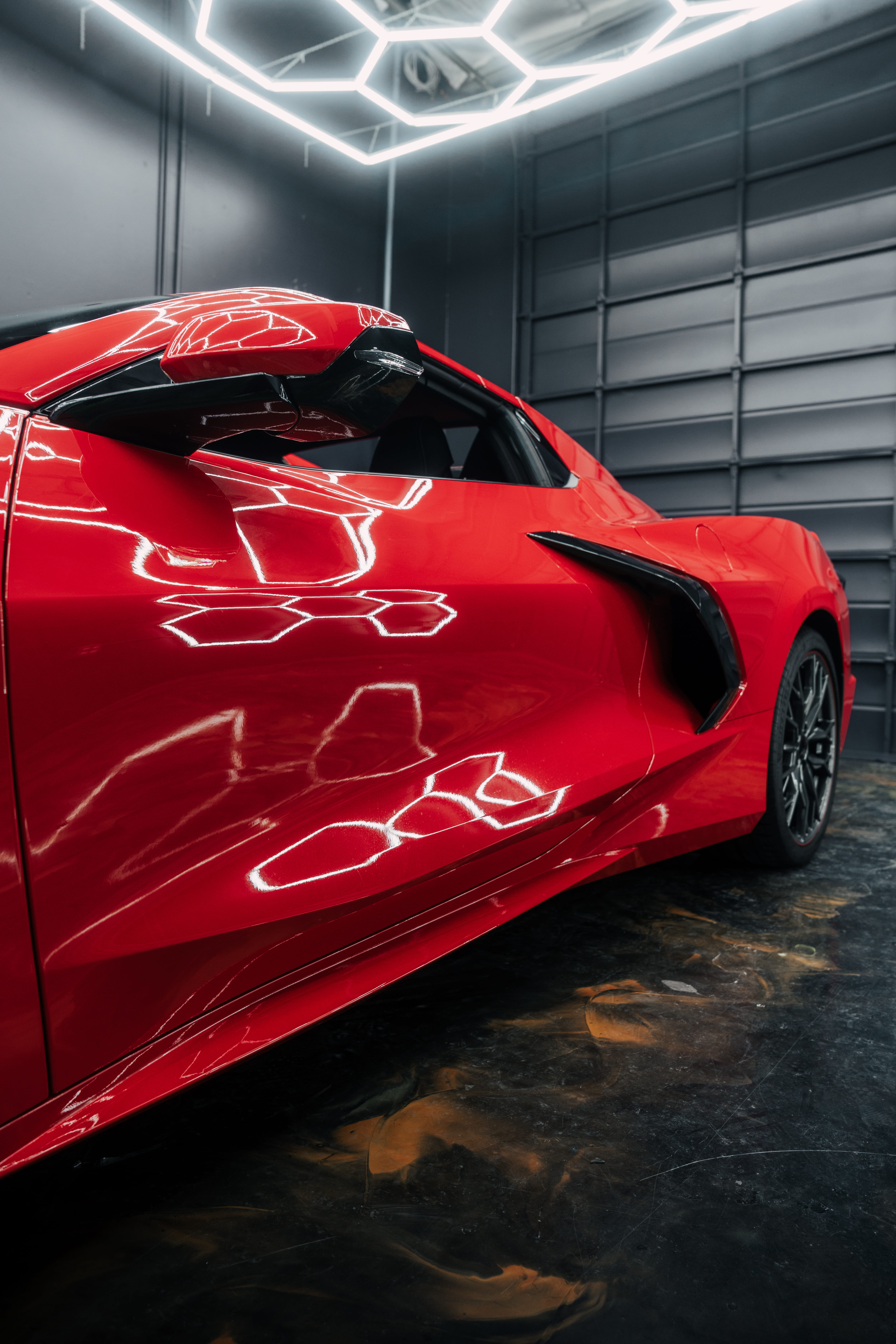
After years of installing film and coatings, we landed on Icon Rocklear because it does what ceramic can't and lasts in a way film doesn't. It's a permanent coating that bonds directly to your paint and cures thicker than your factory clear coat, and it's neither ceramic nor film. That thickness is the whole story, because it deepens the gloss and pulls the metallic flake out, and our clients keep describing the result as better than new. It doesn't yellow, and it has no seams to trap dirt. It goes on by hand, panel by panel, so we get into every curve and body line and do a whole section in one piece with no seams anywhere, and that's also why a scratch in it can be sanded and polished out instead of thrown away. The 15-year warranty is backed by 4,000 hours of harsh lab UV testing that simulates a car parked outside in the sun around the clock, so it's a worst-case minimum, and a garaged car will see more than fifteen years. When it finally does wear, you add more and build it back up with no stripping, and the clear coat underneath stays untouched. On chips, Rock Chip Protection Front puts three layers on the hood, front bumper, both fenders, and the mirrors, which leaves significantly fewer chips than a bare front end. It's chip resistance, and it isn't chip-proof. PPF is a softer material and may absorb a hard direct hit better than we do, but it costs thousands more to put on. Ceramic still has a place here, it just isn't your paint, and Rocklear customers can add it to the job for the glass, the trim, and the wheels, where brake dust is the real enemy anyway. We do free consultations at the shop, no upselling and no pressure, so tell us how you drive and where you park, and we'll point you to the package that fits.
Keep reading
More from
the shop
Owner check-ins, install standards, and straight answers about what a coating does.
- The Honda Fit we were not even supposed to restore
- What a proper Icon Rocklear installation should look like
- Icon Rocklear quality control: what happens after installation
- A Nissan R35 GTR, start to finish
- Deep scratch repair: what a coating can and cannot fix
- A track driven ZL1 Camaro gets film repair and a permanent finish
- Behind the scenes on a 2021 Toyota Tacoma
- Saving carbon fiber from sun damage on a 2022 BMW 330i
- Icon Rocklear Reddit reviews: what Reddit gets right, and what it misses
- Is Icon Rocklear worth it? An honest answer from the shop that installs it
- What happens to your deposit if you change your mind
- Our quotes take five seconds now. The hard part was not the AI